Friday, June 18, 2010

Sailing

I had the pleasure of joining a dozen colleagues on board the Vega to watch the sunset last evening. The sailing ship, built in Norway in 1893, is a beauty -- as you can see. The mast is actually older than Vega. It was taken from another sailing ship when Vega was constructed more than 100 years ago. Vega's currently anchored in Dili harbor.
Captain Shane Granger says his mission over the next two weeks or so is to provide humanitarian assistance to Timorese people -- in the form of medical and educational supplies.
The ship is 85 feet long and has three suites. Its cruising speed is 6 to 8 knots.
For more than a 100 years, Vega ferried cargoes of bricks, building stone, iron and cement.Hans Peter Christophersen, the head of mission at the Norwegian Embassy, presented Captain Granger and his partner Meggi Macoun with official Norway caps. Granger says his dream is to obtain Norwegian registry for his vessel.

Wednesday, June 16, 2010

Romain Gary aka Emile Ajar

I'm reading Promise at Dawn and it just might be the most beautiful book I've ever read. I don't write these words lightly.

The book, which is autobiographical, is a love story between Gary and his mother -- and yet so much more -- philosophy, adventure, self-discovery and lots of humor.

Romain Gary's descriptions are so unique. For instance, he recalls the first time he sees the sea and the profound effect it had on him. "I am unable to think of the sea as a mere 'it' - for me she is the most living, animated, expressive, meaningful, living thing under the sun. I know that she carries the answer to all our questions, if only we could break her coded message..." Page 104.

The book is full of observations like this.

At times, I laugh out loud -- as he finds humor even in tragedy.

Gary paints with words. The book is a work of art.

Tuesday, June 15, 2010

Juxtaposition

I was bouncing around in a pickup truck on a dirt strip along the Timor coast last weekend -- listening to the music on my flash key as I was dodging mud holes.

One of those songs, that I had forgotten was on the flash, was by Toni Childs. So, here I am driving right by the seashore when her song "Where's the Ocean" comes on. She just kept singing "where's the ocean, where's the ocean, where's the ocean."

I guess it was the juxtaposition of the song and where I was at that moment -- I suddenly burst out laughing. It just seemed so ridiculous.
Why the ocean is right here! You can see the white pickup in the distance.

Monday, June 14, 2010

Flickering Lights

Each afternoon, shortly after lunch, the florescent lights in the office begin to flutter. The UPS units, which provide a few minutes of battery power to the PC's, begin to beep and suddenly the office is plunged into darkness.

Life in Dili, lately.

The power interruptions are becoming more regular -- and are lasting longer.

Saturday, one line into the compound was off seven hours -- which meant no water. I also noticed the refrigerator was off -- so I re-routed it to a working outlet.

Today, the power went out and the generator worked, but it was sickly. It was belching smoke and whining most of the afternoon. I expect it will need replacing. When it runs, all the air conditioners must be turned off -- most computers don't work and we're lucky if the server -- which supplies internet -- keeps working.

Yet....we're lucky. These power interruptions are nothing compared to what people living outside Dili have to contend with: no power -- all day, every day. It comes on each evening at 6pm and goes off around midnight. Like I said -- we're lucky.

Saturday, June 12, 2010

An American Tragedy

I had never read Theodore Dreiser's book "An American Tragedy." I don't even remember it on any reading lists from high school. I'm not sure why. It's a pity.

The book is a classic.

With his narrative, Dreiser's able to paint his characters in such a way as they leap off the page. I felt sympathetic toward each of the characters -- even Clyde -- I didn't want him to get away with what he'd done, but I still felt for him.

Dreiser, in some ways, reminds me of Dostoevsky, particularly "Crime and Punishment." Both books are powerful psychological dramas -- with the element of redemption-through-religion -- playing a role. Although in "An American Tragedy" Clyde is unable to make the leap to faith.

By the last few lines of the book, you realize Dreiser has come full-circle.

Tumble Weeds

You find this plant along the beach. The seeds are in the center of these spoke-like needles. When they turn brown, they break away from the main plant and roll across the beach and start life anew. They almost perform a dance as the wind moves them first one way and then another. This plant was photographed east of Dili at a place nicknamed "dollar beach." Locals, apparently, used to charge a buck to expats who wanted to use this beach. Today, it's free.

Friday, June 4, 2010

Driftwood

Wednesday, June 2, 2010

Maubisse Market

The Sunday morning market in Maubisse is not to be missed. Being a crossroads town, Maubisse has some of the best vegetables around. Here are a few pics from a morning at the market in late May.
Chilies! They are quite hot!

Maubisse is coffee country and below are coffee beans that haven't yet been roasted. If you were to close your eyes and smell them, you'd never know they were coffee beans.

Jacket, Please!

I never thought I would write about the joys of wearing a jacket. I also never thought that 60 degrees would be considered cold. Yet, when I traveled into the mountains of Maubisse two weeks ago, I did take my jacket, even though the temperature in Dili was a humid 92 degrees. I felt a bit silly carting it along, but was glad I did.

As soon as our vehicle began to climb into the mountains, the temperature began to drop along with the humidity. By the time we reached Maubisse, three hours later, it was a very pleasant 65 -- and the fog was starting to roll in -- by nightfall, I needed my fleece. The temperature dropped to around 60.

It had been a long time since I'd worn a jacket. It felt strange, but comforting. I realized that I missed wearing jackets. There was something kind of quaint about it -- particularly on a tropical island where it is almost always hot and humid.

The fog rolling in and the rain shower that followed was absolutely fantastic -- I hadn't seen fog in a long time -- and then just before sundown -- a beautiful rainbow.

Saturday, May 15, 2010

Bye Bye Holiday

I spent a lot of time here -- the hotel swimming pool in Legian -- like in Dili, it's the rainy season in Bali, but I loved the overcast skies -- a break from the sun.

When not shopping, rafting or visiting bird and reptile parks, I was reading Christos Tsiolkas' book The Slap -- pool side - surrounded by friendly Australians. The book offers a glimpse into life in Melbourne in the double-aughts. It focuses on an incident at a party -- a slap -- and how it affects/changes the lives of the various characters. It's written by a Greek-Aussie. At times, I almost need a translation -- particularly when characters refer to "bogans" -- something along the lines of a redneck -- and when the writer uses the word "arvo" which is short for afternoon.

I highly recommend this book.

The poolside photo show Krishna riding behind Arjuna on his chariot -- the pool attendant is giving the horses a good cleaning.


Thursday, May 13, 2010

Birds and Reptiles

The Bali Bird Park is truly impressive. The brochure says 250 species of birds. Here are a few of them, along with a photo or two from the Reptile Park located just next door.


Bali - Around Legian

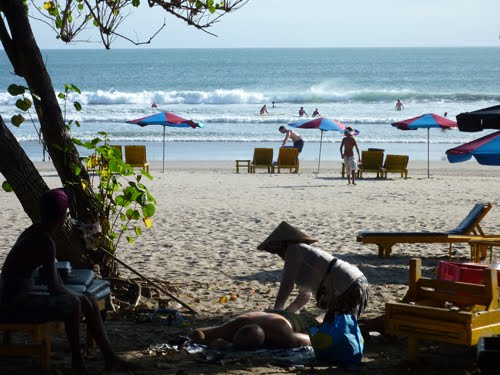
Armed with my camera, I go for strolls daily around the neighborhood of my hotel -- along the beach, the narrow streets, the shopping districts. There's always gamelan music nearby -- it is subtle and kind of drifts through the air like the wonderful incenses that are burning at the tiny temples -- seemingly 50 feet apart -- tended by girls and women -- who also make fruit offerings to the Gods -- oranges, mangoes, apples and -- even the occasional cigarette.
One of my favorite supermarkets in Seminyak. It's called Bintang (as in the Indonesian beer).
Drumming on the beach at night in Legian.
The resting Buddha at the hotel restaurant.
Coke is everywhere -- even right outside the temple gate.
Buy a trinket and get a massage -- all in one -- on the beach in Legian.
Surf's up!

Thursday, May 6, 2010

Bali - Normal vs Exotic

I was chatting with a colleague the other day in Dili, the day before I flew to Bali. We both agreed that Bali is exotic depending on where you are coming from in the world. If you are coming from...say...Australia or the United States, Bali would certainly feel "exotic."

If, however, you are coming from a place like Timor-Leste -- Bali just feels normal. That's not to say I don't like Timor-Leste. I do. It is my home. However, in Bali, there is a lot more to do -- museums, great restaurants, ice cream that hasn't been thawed and re-frozen several times, stable electricity, white-water rafting and lots of shopping.

I am not a shopper, per se, but I do enjoy the option -- particularly window-shopping.

Timor-Leste has lots and lots of potential -- in terms of becoming a tourist destination. It'll get there, one day. It has incredible landscapes, amazing coral reefs and friendly people.

Friday, April 30, 2010

May Day 2010 - Timor-Leste

Timorese workers braved the heat and humidity today to mark International Workers' Day or Labor Day.

Remembering Tajikistan 2007 on May Day

Mosaics like this in northern Tajikistan were created during the Soviet period as a public works project. Many of these colorful "works of art" still dot the countryside, but most are beginning to fade with time and no funds for restoration.

The guy below is also beginning to fade from view -- although he still stands guard outside a government building in Khujan, the second largest city in Tajikistan.
Pristine rivers like this one -- about 50 kilometers outside Dushanbe, the capital -- can turn into raging torrents after a heavy rain. This was a particularly beautiful May day in 2007. It goes without saying -- when the river rises -- the road disappears.
The road above leads to a trail that leads to the mountain lake below.